
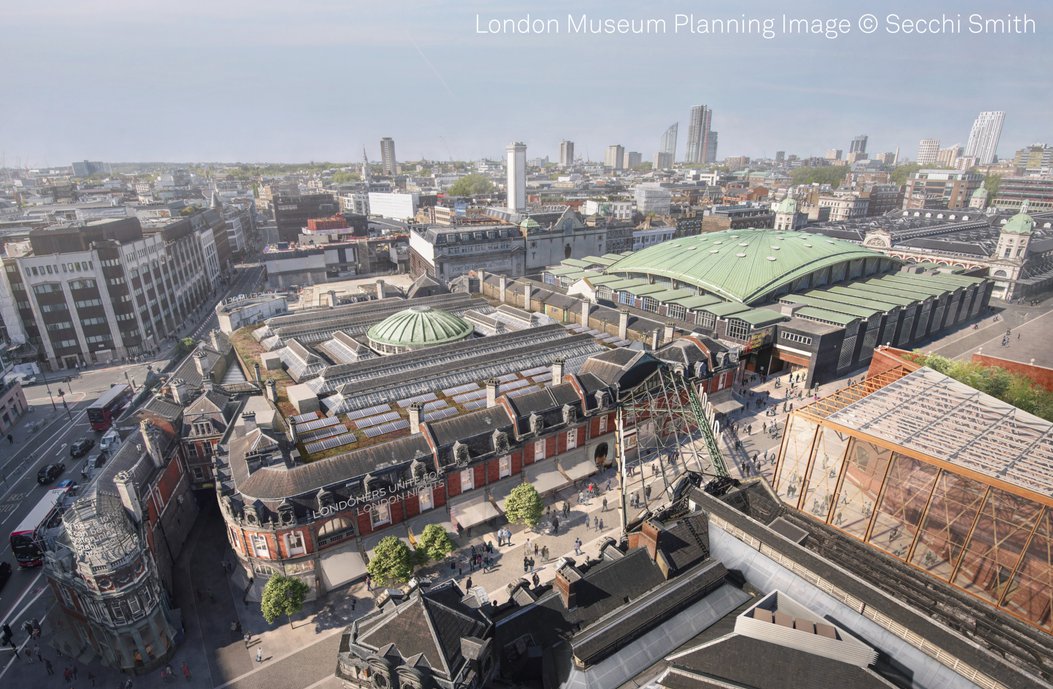
As one of Europe’s most ambitious cultural redevelopments, the new London Museum at Smithfield stands as a landmark destination in the heart of the capital. Severfield’s expertise in structural steelwork has been pivotal in delivering the complex framework supporting this historic transformation.
- Location
- Smithfield, London
- Client
- London Museum
- Main Contractor
- Sir Robert McAlpine
- Engineer
- AKT
- Tonnage
- 600
The mid-century Poultry Market was reimagined from the inside out, with Severfield delivering a 600-tonne steel package including approximately 150 tonnes of Fabsec plate girders to support its reinvention as the home for the museum’s temporary exhibition spaces, collection stores, and learning centre. Although the façade remained largely intact, the internal structure was completely rebuilt to meet the needs of a modern, world-class museum.
Working within the constraints of a retained structure presented significant technical and logistical challenges. Severfield joined the project partway through demolition, with access to the site limited to a single opening measuring 3.5m by 2.8m at ground level. To overcome this, the team constructed a bespoke derrick crane within the basement, carefully lowering large steel sections, some over 15 metres long and weighing up to 5 tonnes, through the tight entry point. Once inside, beams had to be skated through dense temporary propping and original features with absolute precision.
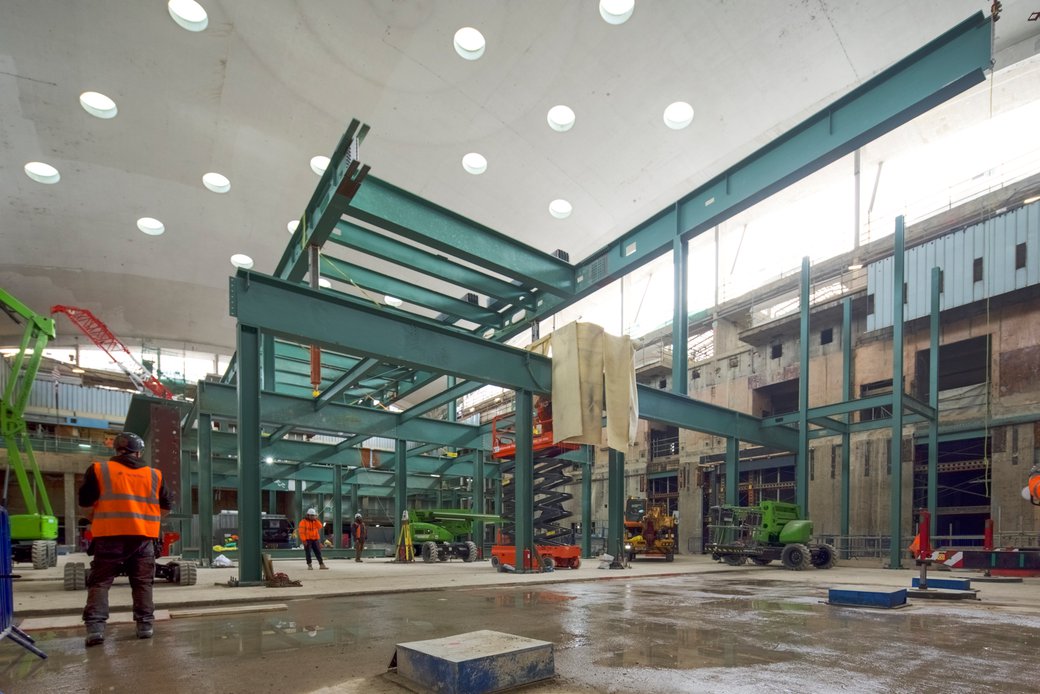
Preservation was a top priority throughout the project. The steelwork was designed to support and protect the retained concrete structure, utilising perimeter framing and over 250 kg brackets to reinforce delicate areas. In many zones, drilling was not an option due to the fragility of the original materials; therefore, everything had to be scanned, planned, and coordinated with meticulous detail.
Severfield delivered the project in partnership with Sir Robert McAlpine and was funded by the City of London Corporation, London Museum, the Mayor of London, Sadiq Khan, and a range of philanthropic supporters, forming an innovative £437 million investment into London’s future.
Sustainability was at the heart of the development. The project aimed for a BREEAM Outstanding rating and was on track to retain and recycle 70% of the existing building fabric, divert 95% of construction waste from landfill, and reduce operational carbon through smart building technologies that monitored and optimised performance over time.
Severfield’s structural steel forms the backbone of the new London Museum, supporting a cultural landmark that would inspire and welcome millions for decades to come. Though often unseen, this work was essential, powering a new era where heritage and engineering drove London’s future.
Within this project, it was also important to leave a lasting legacy within the community. We spent a number of hours volunteering for various causes – this included gardening at the Royal Trinity Hospice, delivering supported sessions on careers in construction alongside Construction Youth Trust, and number of charitable donations. We also launched a new partnership with Tech-Takeback, social enterprise for tech reuse and digital inclusion. Tech-Takeback believes in a world where discarded tech is refurbished for social good, which leads to reduce e-waste, carbon emission savings, and enhanced digital inclusion. By working with Tech-Takeback we were proud to support digital inclusion within the area by donating five laptops to local young adults, who had been facing long-term unemployment.


